Choose a prompt, reference images, a blueprint set or an admitted capture. Select the target cell and
build recipe, then keep the source, preflight and run evidence in the same spatial project.
The current release handles source admission, recipe selection, preflight and run inspection. Full
prompt-to-world provider execution remains an integration target.
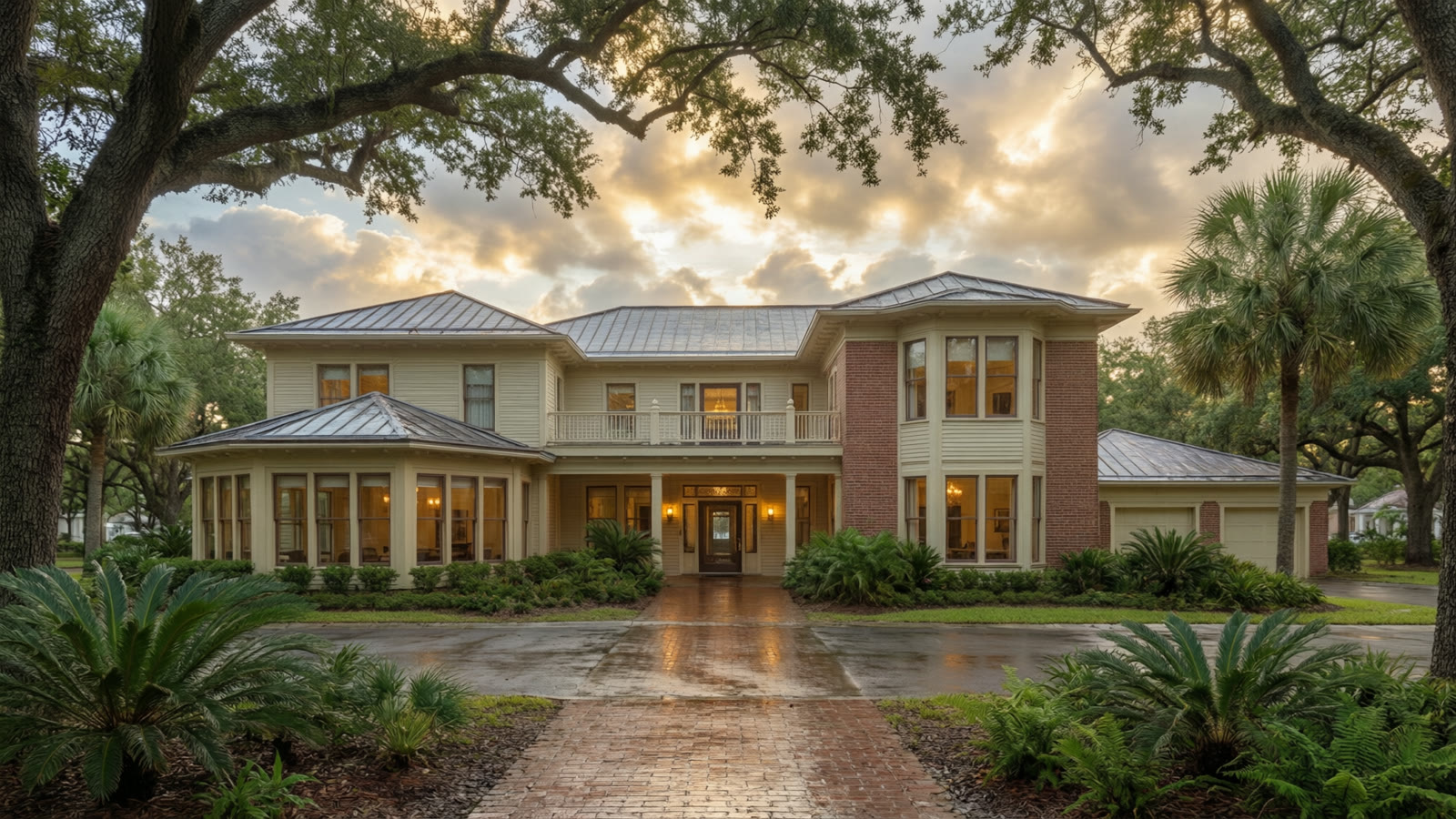
The first capture experiment began from a generated front elevation. It predates the measured structure
and exact-camera FLUX studies documented in the Case Study.
A traced plan and style brief produced this image. The evaluation loop compares candidate motion, solves
cameras, trains registered views and scores held-out views. Its narrow front coverage defined the need for
exact multi-angle references.
Legacy generated front elevation. The source PNG has no camera EXIF and carries
its generation provenance. Treat it as an appearance reference; no camera ever measured this view of the
property.
The source image shows
2 stories, 4 porch columns,
3 balcony bays, a five-sided brick bay tower on the right and a single-story
glazed sun-room on the left. The asymmetry distinguishes the intended orientation from mirrored or
structurally changed frames.
05Model comparison
Seven video models started from the same frame.
All seven ran from the identical generated still with the same prompt and negative prompt, then faced a
local screening proxy: feature continuity, camera motion, source retention, cut safety. Thirteen runs
across two scenes, $8.44 actual against a $9.00 budget.
The proxy ranked Veo first at 90.9 and Kling fifth at 85.3.
Structure from motion reversed that order: Kling reconstructed and Veo failed. The proxy filters obvious
visual failures. Camera recovery determines whether a clip contains usable multi-view geometry.
Screening formula: 35% feature continuity, 25% camera motion, 25% source
retention and 15% cut safety over SIFT correspondences with RANSAC fundamental geometry. Persistent 2D
texture can score without coherent multi-view structure, so every passing clip also receives a camera solve.
06Camera recovery
Camera recovery gates every clip before training.
Each clip goes to structure from motion under pinned intrinsics, and the score counts how many of
210 image pairs return a geometrically calibrated relationship. A clip with no stable
camera solution stops before any paid generation or reconstruction training.
Camera recovery and visual quality are separate review gates. The high-scoring a150 guide failed on
roofline and foliage artifacts. The pb100 guide failed local camera recovery and stopped before generation.
Camera guides · solved locally before generation
Superseded
t025 · dolly parallax
calibrated pairs
124 / 210
family
r6
The first guide that produced a solvable generation at all.
Selected arc
a100 · 1.00u truck, 18° sweep
calibrated pairs
189 / 210
points
8,275
The middle arc of the r7 family, selected for the next generation.
Rejected: visual artifacts
a150 · 1.50u truck, 26° sweep
calibrated pairs
198 / 210
solve
21/21 · 7,714 pts · 0.847 px
why out
roofline bend, foliage smear, 5 watermark pairs
Highest guide solve score; rejected for roofline bending, foliage smear and five watermark pairs.
Best parallax
l100 · lateral dolly 1.00u
guide pairs
190 / 210
clip pairs
206 / 210
points
8,060 · 0.765 px
The guide calibrated 190 of 210 pairs; its generated clip calibrated 206.
Rejected: camera solve
pb100 · pure pull-back
two-arm solve
no sparse model
fallback
8 / 21 · 122 pts
saved
$0.50625
Pure pull-back motion supplied insufficient lateral parallax for mapper initialization, so the candidate
stopped after the local solve.
Local preflight result
Six candidates were rendered and solved locally at no cost.
Five passed at 21/21 registered, 0.73 to 0.82 px, zero watermark-configuration pairs. One failed outright.
Paid generation proceeded for the five passing guides.
candidates
6
passed
5
paid on failures
$0.00
Generation sequence
Rejected
R2
degenerate pairs
210 / 210
Visual review passed, but every pairwise solve collapsed into one degenerate camera configuration.
First pass
R3
calibrated pairs
132 / 210
points
8,576
The first generated clip that reconstructed at all.
Arc baseline
R4
calibrated pairs
184 / 210
points
10,480
holdout
27.78 dB
Sharpest within its solved arc; unsupported views collapse outside that range.
First corner gain
Orbit hop 1
joint solve
128 / 128
coverage
35.4° → 53.7°
calibrated
204 / 210
Strongest parallax in the project, and the first view past the corner.
06bHoldout PSNR
A controlled baseline anchors reconstruction comparisons.
A controlled re-derivation of the strongest prior generated clip measured 30.34 dB
on its held-out split. Later candidates use this value only when the evaluation protocol matches.
The strongest generated candidate in this study measured 27.78 dB. Direct viewer
review remains a separate gate because a reconstruction can score well inside its source arc and fail as
soon as the camera leaves supported coverage.
07Blueprint Studio
Four reviewed states open in one spatial environment.
Choose the accepted front appearance, the geometry-propagated surface study, the held full-turn research base
or the playable great room. Each state opens in the canonical Studio with its camera, review scope and
evidence attached.
Camera, Render, Edit and Evidence operate around the same world while the visible representation changes.
Current bounded exterior appearance, reviewed across a six-degree front arc.
Measured viewing range for each reconstruction.
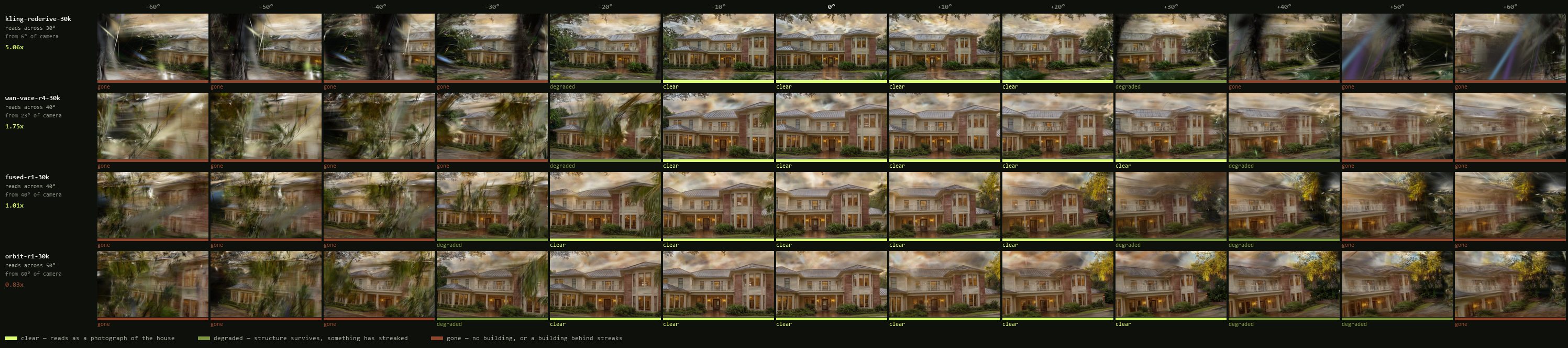
Viewing bounds are based on direct review of
52 renders: four models at thirteen azimuths in 10° steps, each marked
clear, degraded or gone. Two automated alternatives were rejected. Sharpness rises when
Gaussians stretch and foliage fragments. Solved camera positions describe capture locations; direct review
establishes the readable range.
Direct-review frames at their evaluation size. Scroll sideways. Along each row the
house remains readable through the middle and then breaks up, with earlier failure
on the left: turning left reaches an unresolved foreground oak and palm, while turning right
opens onto the driveway the clips did cover. Every model reaches farther right than left, requiring asymmetric
viewer limits.
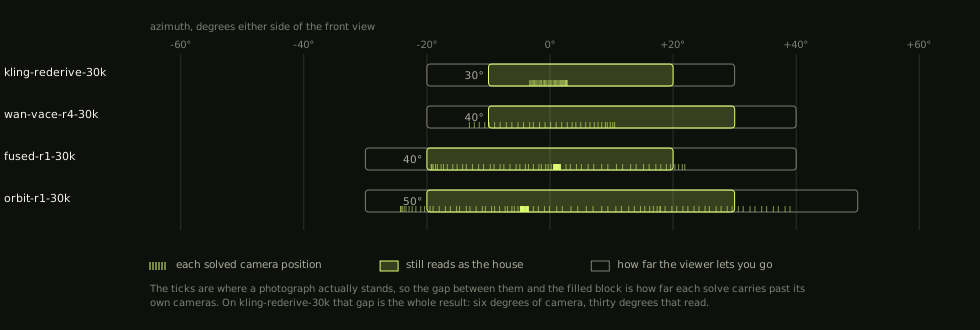
Ticks show solved camera positions, the filled band shows direct visual acceptance
and the outline shows the viewer clamp. Capture positions and readable viewing range remain separate measures.
kling-rederive-30k now opens across 30°, compared with its
5.9° solved-camera span.
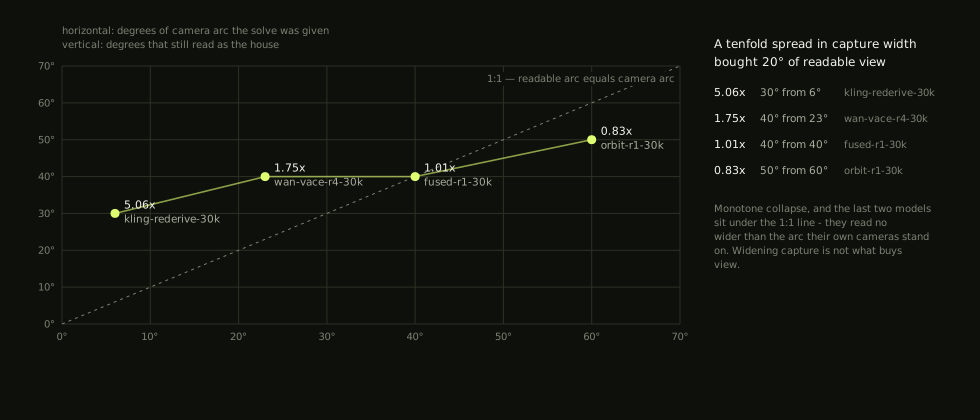
Readable range saturated as capture widened.
Across the four models, readable degrees gained per camera degree fall
away steadily: 5.06× readable degrees per camera
degree, then 1.75×, then 1.01×, then 0.83×. A
10× spread in capture width bought
20° of additional readable view, and the two widest captures return
their own solved arcs and little more. Beyond a point, the win has to come from source appearance and
reconstruction quality.
Above the dashed line, readable range exceeds the camera arc; below it, the
reconstruction returns less range than the captured cameras. Data:
splat-arc-bands.json.Viewer-range provenance
The current bands were generated from the sealed
viewer-arc-20260811-r2 manifest. The replaced instrument and its full-resolution
frames remain in the archive as rejected range evidence.
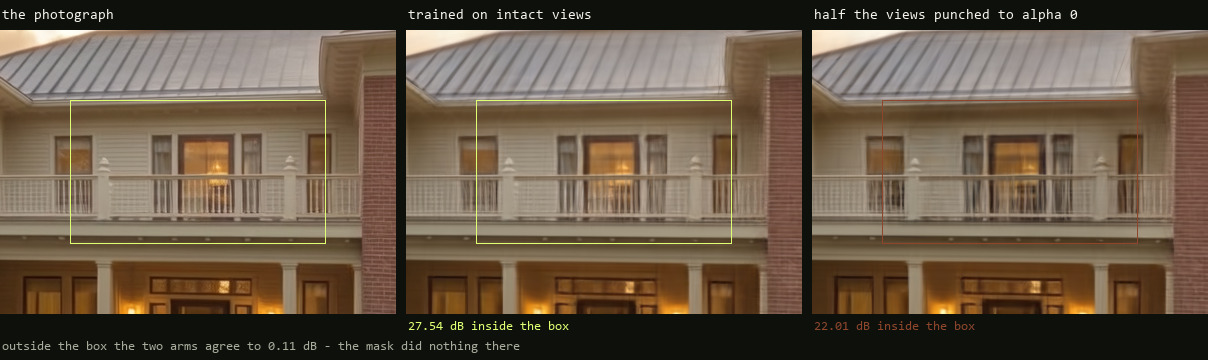
Transparent training masks were read as empty space.
Feeding generated frames into a reconstruction costs
−1.43 dB against a baseline built from solved frames alone, measured on held-out
views. A warped frame mixes resampled source pixels with invented
disocclusions, and the warp records that provenance per pixel, which suggested marking invented regions
transparent so the trainer could ignore them. A controlled test punched a rectangle to transparent in half the
training views to see which way the trainer reads transparency; the other views and all training settings
stayed untouched.
Transparency was interpreted as empty space. Inside the masked rectangle, held-out
quality fell by 5.53 dB; outside it, the two arms differed by
0.11 dB. The effect ends at the rectangle boundary, and setting alpha-loss weight
to zero leaves it active.
So transparency means empty space to this trainer, and masking real
disocclusions that way deletes geometry other views actually support. Two short training runs completed in
about four minutes. The result ruled out a larger per-pixel masking experiment. Whole-frame selection by
invented-pixel fraction remains untested.
Alpha-semantics provenance
The controlled result is preserved as refuted in
alpha-semantics-20260811-r1. It stopped the larger per-pixel masking experiment
before additional training.